
BAKING AND PASTRY TOOLS
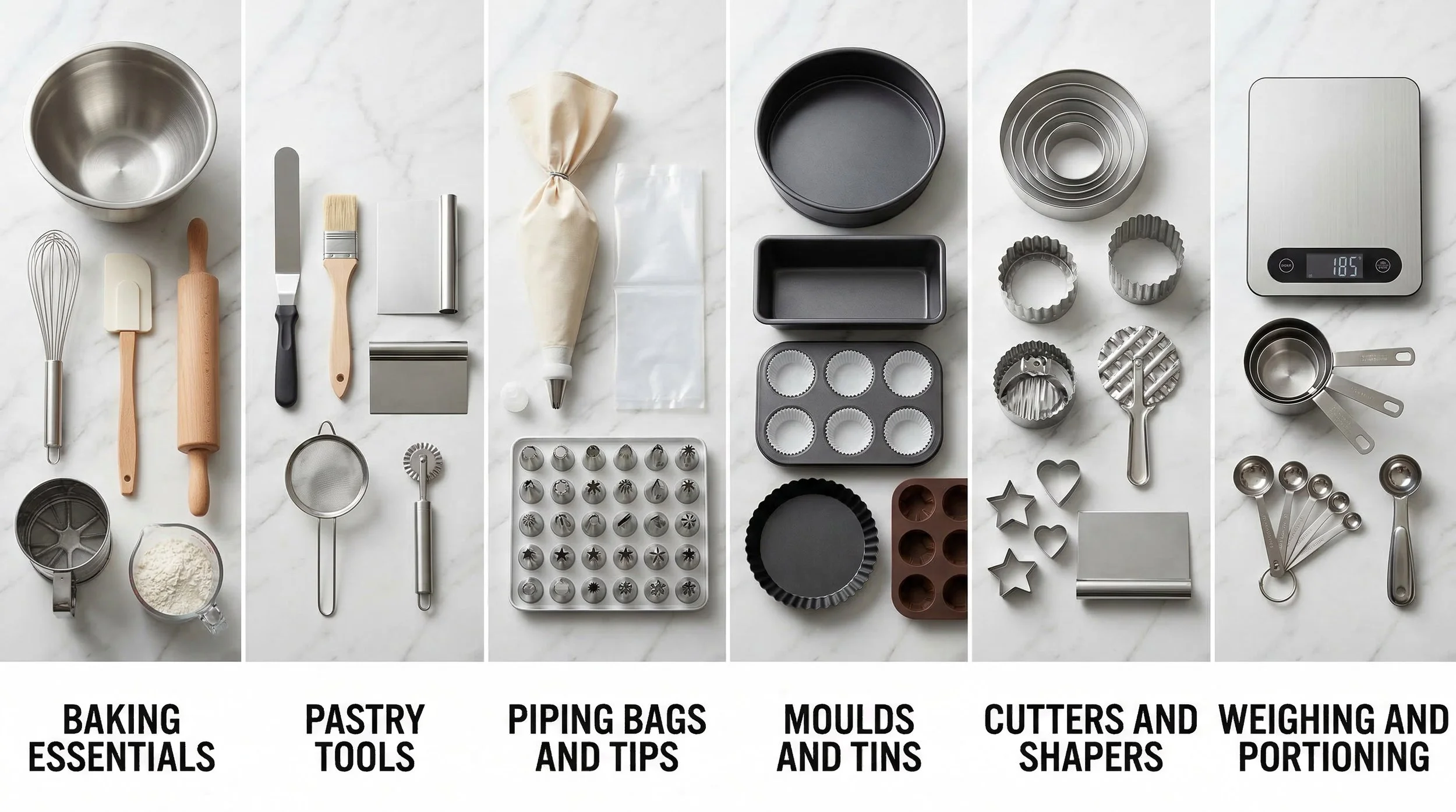
Baking & Pastry Tools — The Complete Guide
Whether you're making your first sponge cake or attempting a multi-tiered celebration cake, having the right tools makes all the difference between frustration and success. Baking is precise, methodical, and deeply rewarding — and the equipment you use directly affects the results you get. Here's a complete guide to every baking and pastry tool worth knowing about.
Essential Baking Equipment for Beginners
Before anything else, every beginner baker needs a core set of reliable, versatile tools that will carry them through the vast majority of recipes. You don't need everything at once — but these are the non-negotiables.
Mixing Bowls
A set of mixing bowls in varying sizes is the starting point of almost every baking recipe. Stainless steel bowls are the professional choice — lightweight, durable, non-reactive, and easy to clean. They can also be placed over a saucepan of simmering water to create a bain-marie for melting chocolate or making custards. Glass bowls are a practical alternative — heavier but transparent, which lets you see exactly what's happening to your mixture. Avoid plastic bowls for serious baking — they retain grease and odours over time, which can interfere with delicate preparations like whipping egg whites.
Baking Tins and Trays
The baking tin is where your batter becomes a cake, your dough becomes bread, and your pastry becomes a tart. Every beginner needs a basic collection — a round cake tin in both 20cm and 23cm sizes, a loaf tin, a muffin tray, and a flat baking sheet. Non-stick finishes are convenient but shouldn't be relied upon entirely — always grease and line your tins for reliable results. Heavy-gauge aluminium tins conduct heat evenly and resist warping, making them the best choice for consistent baking.
Baking Paper and Silicone Mats
Baking paper — also called parchment paper — is one of the most useful things in any baker's kitchen. It prevents sticking, makes cleanup effortless, and can be used to line tins, wrap pastry, and make piping bags in a pinch. Silicone baking mats are a reusable, eco-friendly alternative that sit directly on a baking sheet — non-stick, heat-resistant, and washable. They're particularly good for macarons, tuiles, and any delicate biscuit that needs a perfectly flat, non-stick surface.
Rolling Pin
The rolling pin is essential for any baker working with pastry, cookie dough, or fondant. A classic wooden rolling pin with handles is the most common choice, but many professional bakers prefer a straight French rolling pin — a smooth, tapered cylinder with no handles — which gives far greater control over pressure and thickness. For pastry work, a cold rolling pin is an advantage — marble or stainless steel rolling pins stay cool and prevent butter-based pastry from warming up too quickly as you work.
Pastry Brush
The pastry brush is a simple but essential tool used to apply egg wash, melted butter, glazes, and syrups to pastry, bread, and cakes. Silicone brushes are more hygienic and easier to clean than traditional bristle brushes — they don't shed bristles into your food and can be put in the dishwasher. A traditional natural bristle brush, however, applies liquid more gently and evenly — particularly useful for delicate glazing work.
Wire Cooling Rack
Often overlooked but genuinely important, the wire cooling rack allows air to circulate underneath baked goods as they cool, preventing condensation from forming on the base and making the bottom of cakes and biscuits soggy. Always transfer baked goods from their tin to a wire rack as soon as they are cool enough to handle. A rack with closely spaced wires is better for smaller items like cookies and petits fours that might otherwise fall through wider gaps.
Sieve and Sifter
Sieving flour before use aerates it, removes lumps, and produces a lighter, more even bake. A fine mesh sieve is also used for dusting icing sugar and cocoa powder over finished cakes, pressing soft fruits to make smooth coulis, and straining custards and creams. A drum sieve — a wide, shallow sieve with a fine mesh stretched across a frame — is the professional choice for sifting large quantities of flour or icing sugar quickly and efficiently.
Professional Pastry Tools and What They Do
As your baking develops beyond the basics, a new set of more specialised tools opens up a wider range of techniques and finishes. These are the tools that separate competent home baking from truly professional results.
Bench Scraper
The bench scraper — also called a dough scraper or pastry scraper — is a flat, rectangular blade with a handle along one edge. It's one of the most versatile tools in a professional pastry kitchen. It's used to divide and portion dough, clean flour and dough from the work surface, smooth the sides of frosted cakes, transfer chopped ingredients from the board to the bowl, and create sharp, clean edges on ganache and buttercream. Once you start using a bench scraper, you'll reach for it constantly.
Palette Knife
The palette knife has a long, flexible, blunt-edged metal blade — available straight or offset — and is the essential tool for spreading, smoothing, and lifting. In cake decoration it's used to apply and smooth buttercream and ganache. In pastry it lifts delicate biscuits and pastry pieces from the work surface. In the kitchen it transfers food from pan to plate with precision. An offset palette knife — where the blade is set at an angle from the handle — is the most versatile option, giving you clearance to work flat across a surface without your hand getting in the way.
Pastry Comb and Scraper
The pastry comb is a flat tool with a serrated or patterned edge used to create decorative textures in buttercream, ganache, and chocolate. Dragged along the side of a frosted cake, it produces clean, even ridges or patterns that elevate a simple finish into something elegant and professional. Metal combs give sharper, more consistent results than plastic alternatives.
Dough Divider and Cutter
In professional bread and pastry kitchens, consistency of portion size is critical — both for even baking and for presentation. A dough divider cuts portions of dough to equal weights quickly and cleanly. A multi-wheel pastry cutter — a tool with multiple parallel cutting wheels — divides rolled pastry or dough into equal strips in a single pass, saving significant time when making lattice tarts, pasta, or puff pastry items.
Larding Needle and Pastry Wheel
The pastry wheel — a rotating blade on a handle — cuts clean, straight or decorative edges in pastry and dough. A straight wheel cuts cleanly through shortcrust, puff, and fresh pasta. A fluted wheel creates a crimped, decorative edge on tarts, ravioli, and biscuits. It's a simple tool, but the clean result it produces is noticeably more precise and professional than cutting with a knife.
Cake Turntable
The cake turntable is one of the most transformative tools for anyone who decorates cakes. It's a heavy, rotating platform — ideally with a non-slip base — that spins smoothly as you apply and smooth frosting. Working with a turntable allows you to keep your palette knife or scraper stationary while the cake rotates into it, producing smooth, even sides and a level top that is nearly impossible to achieve without one. Professional turntables are cast iron or aluminium — heavy enough to spin smoothly and hold still when needed.
Piping Bags, Moulds, and Cutters
These tools are where baking crosses into artistry. They're the instruments of decoration, shaping, and presentation — the difference between a cake that tastes great and one that looks extraordinary.
Piping Bags
The piping bag is the decorator's most essential tool. Filled with buttercream, royal icing, whipped cream, choux paste, or ganache, it allows precise, controlled application of any workable mixture through a fitted nozzle. Disposable plastic piping bags are the professional standard — hygienic, easy to use, and quick to change between colours and mixtures. Reusable fabric or silicone bags are a sustainable alternative but require thorough cleaning between uses.
Using a piping bag well is a skill that takes practice. Fill the bag no more than two-thirds full, twist the top closed, and apply consistent, even pressure from the top rather than squeezing from the sides. The angle at which you hold the bag and the pressure you apply determine the shape, height, and consistency of your piped decoration.
Piping Nozzles and Tips
The nozzle — or tip — fitted to the piping bag determines the shape and style of the piped decoration. A few essential nozzles cover a wide range of applications. The round nozzle in various sizes pipes dots, beads, writing, and the shells of choux pastry and macarons. The star nozzle — open or closed — pipes rosettes, swirls, shells, and borders. The petal nozzle creates flowers and ruffles. The Saint-Honoré nozzle produces the distinctive ribbed cream swirls of the classic French pastry. A starter set of six to eight nozzles covers the vast majority of decorating needs for most bakers.
Cake Moulds
Moulds give shape, structure, and presentation to baked and chilled desserts. The range available is enormous — from simple round and square cake tins to complex silicone moulds in geometric, floral, and architectural shapes used in modern patisserie.
Springform tins have a removable base and a side clasp that releases the ring, allowing delicate cakes and cheesecakes to be unmoulded cleanly without inverting. Bundt tins produce dramatically shaped ring cakes with decorative fluted sides. Silicone moulds are indispensable in modern pastry kitchens — flexible, non-stick, and available in an extraordinary variety of shapes, they're used for everything from individual chocolate bonbons to complex entremets with mirror glaze finishes.
Tart rings and flan tins — loose-bottomed tins with fluted sides — are used for open pastry cases. Placing a tart ring directly on a lined baking sheet gives the most precise, professional result, as the pastry can be unmoulded cleanly with perfectly straight or fluted sides.
Cutters
Pastry cutters come in an almost infinite variety of shapes and sizes. Every serious baker needs a set of round cutters in graduated sizes for biscuits, scones, pastry lids, and vol-au-vents. Beyond rounds, shaped cutters — stars, hearts, letters, animals, leaves, and florals — are used for decorated biscuits and celebration cakes.
Cookie cutters are typically thin-gauge stainless steel or plastic. Stainless steel cutters are sharper, more durable, and produce a cleaner edge. For intricate shapes, metal cutters always outperform plastic.
Pastry/dough cutters used for viennoiserie and puff pastry work need to be sharp enough to cut cleanly without dragging — a blunt cutter compresses the layers of laminated dough and prevents proper puffing during baking. Always press straight down with a sharp cutter — never twist or drag.
Weighing and Portioning Tools
Precision is the foundation of great baking. Taste and instinct matter enormously in cooking — but in baking, accuracy in measurement is what separates reliable, repeatable results from hit-and-miss outcomes. These tools ensure that every batch is as good as the last.
Digital Kitchen Scale
The digital kitchen scale is the single most important tool in a serious baker's arsenal — more important than any other measuring device. Weighing ingredients by mass rather than volume eliminates the single biggest source of inconsistency in baking — the variation in how ingredients are packed and measured by volume. A cup of flour can vary by as much as 30% in weight depending on how it's scooped; 200 grams of flour is always exactly 200 grams.
A good digital scale should be accurate to one gram for everyday baking. For professional pastry work — particularly chocolate and sugar work, where small variations can affect the final result significantly — a scale accurate to 0.1 grams is worth the investment. The tare function, which resets the scale to zero after each addition, allows multiple ingredients to be weighed directly into the same bowl without using multiple measuring vessels.
Portion Scoop
The portion scoop — also called a disher or ice cream scoop — is a spring-loaded scoop that deposits a consistent, uniform portion of mixture with every press. In a bakery context it's invaluable for portioning cookie dough, muffin batter, and cake pops to exactly the same size, ensuring even baking and consistent presentation across an entire batch. Scoops are sized by number — the smaller the number, the larger the scoop. A number 40 scoop produces a small, uniform cookie; a number 16 scoop is better for muffins and cupcakes.
Dough Divider Scale
In professional bread baking, portions of dough are weighed individually to ensure every loaf or roll is identical in size and therefore bakes in exactly the same time. A dedicated dough divider scale — or simply a reliable digital scale used consistently — makes this process fast and accurate. Consistent portioning isn't just about presentation — unevenly sized pieces will bake at different rates, meaning some are underdone while others are overbaked.
Ruler and Measurements Guide
A stainless steel ruler is a surprisingly useful tool in a professional pastry kitchen. Rolled pastry needs to be a precise thickness; tart cases need to be an exact depth; chocolate decorations need to be cut to consistent dimensions. A ruler takes the guesswork out of all of these tasks. Many professional bakers keep a dedicated stainless steel ruler in their kit that never leaves the pastry section — clean, accurate, and always within reach.
Thermometer for Baking
Temperature precision is critical in baking beyond just the oven setting. Sugar work — caramel, toffee, Italian meringue, and nougatine — happens at precise temperatures that determine the final texture entirely. Chocolate tempering requires the chocolate to be brought through specific temperature points to achieve the right crystal structure for a glossy, snapping finish. A digital probe thermometer accurate to one degree is essential for any baker working beyond basic cakes and biscuits.
Great baking is equal parts creativity and precision. The right tools don't replace skill — but they support it, reinforce it, and give it the best possible chance of producing something truly beautiful. Invest in quality where it matters, learn the purpose of every tool you own, and your baking will reflect it in every single thing you make.