
KITCHEN APPLIANCES
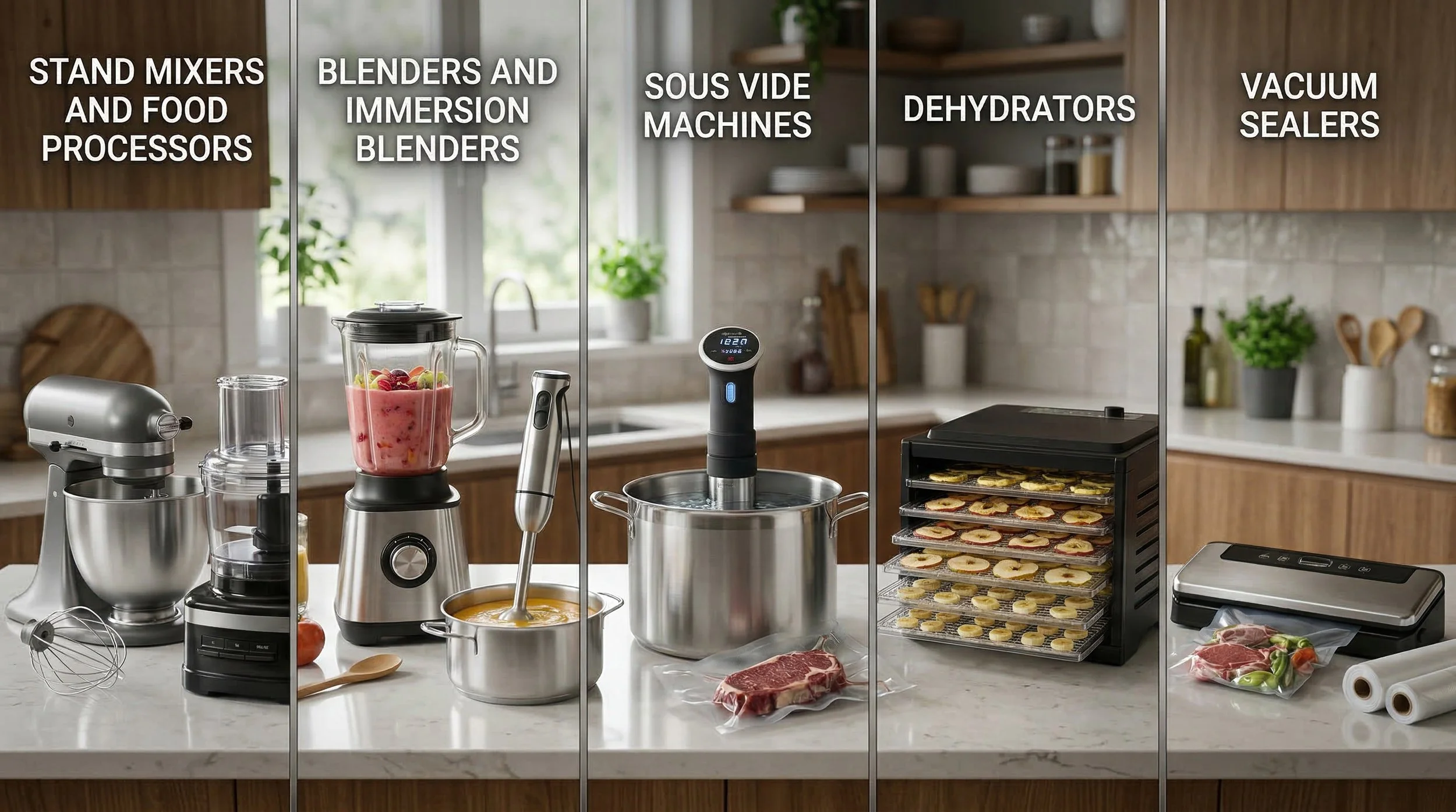
Kitchen Appliances — The Complete Guide
If small hand tools are the backbone of the kitchen, appliances are the muscle. The right appliance doesn't just save time — it opens up entirely new techniques and possibilities that simply aren't achievable by hand. Here's everything you need to know about the most important kitchen appliances and what they can do for your cooking.
Stand Mixers and Food Processors
These two appliances are the heavy hitters of the kitchen counter. Both save enormous amounts of time and effort, but they do very different jobs — and understanding the difference is key to getting the most from either one.
The Stand Mixer
The stand mixer is the baker's best friend and one of the most satisfying appliances to own. A powerful motor drives a rotating head with interchangeable attachments, leaving your hands completely free while it works. The three standard attachments — the flat beater, the dough hook, and the balloon whisk — cover the vast majority of baking tasks between them.
What it's used for: Whipping cream and egg whites to stiff peaks, creaming butter and sugar for cakes, mixing cookie and brownie batter, kneading bread and pizza dough, making meringue, and beating buttercream to a light, airy finish.
Why it matters: Kneading bread dough by hand for ten minutes is hard work. Whipping egg whites to stiff peaks by hand is exhausting. A stand mixer handles both effortlessly and consistently, every single time. The results are also more reliable — the machine maintains a constant speed and action that's impossible to replicate entirely by hand.
What to look for: Motor power, bowl capacity, and build quality are the three key factors. KitchenAid is the most iconic and trusted brand, but several excellent alternatives exist at lower price points. Look for a model with a metal body rather than plastic — it will last significantly longer under regular use.
Chef's tip: Don't overfill the bowl and don't walk away — even a stand mixer needs supervision. Start on a low speed when adding dry ingredients to prevent clouds of flour escaping from the bowl, then increase speed gradually.
The Food Processor
Where the stand mixer specialises in mixing and aerating, the food processor is all about speed and volume in prep work. A powerful motor spins interchangeable blades and discs at high speed, reducing tasks that would take ten minutes by hand to a matter of seconds.
What it's used for: Chopping onions, garlic, and vegetables, making pastry dough, blending hummus and dips, grating large quantities of cheese, slicing vegetables uniformly, making breadcrumbs, blending pestos and sauces, and processing nuts into butters.
Why it matters: The food processor is the great time-saver of the kitchen. Chopping a large batch of onions by hand brings tears and takes time — a food processor does it in seconds. Making shortcrust pastry by hand requires a light touch and practice — a food processor produces perfect pastry consistently and in under a minute.
What to look for: Bowl size, motor power, and the quality and range of included blades and discs. A larger bowl is more versatile but takes up more counter space. Always choose a model with a feed tube wide enough to accept whole vegetables without pre-cutting.
Chef's tip: Don't over-process. The food processor works fast and it's easy to turn a rough chop into a purée in seconds. Pulse rather than run the machine continuously — short bursts give you far more control over the final texture.
Blenders and Immersion Blenders
Both blenders and immersion blenders are designed to blend, purée, and liquefy — but they work in very different ways and excel in different situations. A well-equipped kitchen benefits from having both.
The Countertop Blender
The countertop blender is a tall, powerful appliance with a sealed jug and a blade assembly at the base. It's designed for blending larger quantities of liquid-based ingredients into a completely smooth, uniform result.
What it's used for: Smoothies, milkshakes, frozen cocktails, soups, sauces, nut milks, salad dressings, and pureéing soft fruits and vegetables.
Why it matters: For truly smooth results — velvet-smooth soups, perfectly blended smoothies, lump-free sauces — a countertop blender is unmatched. Its sealed container and powerful motor can handle ice, frozen fruit, and fibrous vegetables that would struggle in a food processor.
What to look for: Motor power is the single most important factor. A weak blender will struggle with ice and fibrous ingredients and leave lumps in your smoothies. High-speed blenders like Vitamix and Blendtec are the professional standard — expensive, but genuinely transformative.
Chef's tip: Never fill a blender more than two-thirds full with hot liquid — steam builds pressure inside the sealed jug and can blow the lid off dangerously. Always start on a low speed and increase gradually, and hold the lid down with a folded cloth for extra security.
The Immersion Blender
The immersion blender — also called a stick blender or hand blender — is a handheld device with a blade at the end of a long shaft that you plunge directly into the pot or bowl. It's smaller, cheaper, easier to clean, and far more convenient for everyday use than a countertop blender.
What it's used for: Blending soups directly in the pot, making smooth sauces, emulsifying mayonnaise and vinaigrettes, pureéing cooked vegetables, and blending small quantities of ingredients.
Why it matters: The immersion blender eliminates the need to transfer hot soup or sauce to a countertop blender in batches — a process that's messy, time-consuming, and potentially dangerous. Instead, you blend directly in the pot and you're done in seconds. It's one of those appliances that once you own it, you can't imagine cooking without.
What to look for: A detachable shaft for easy cleaning, variable speed settings, and a comfortable grip. A splatter guard around the blade head is a practical feature that prevents hot liquid from spraying as you blend.
Chef's tip: Keep the blade fully submerged while blending to prevent splashing. Move it slowly through the pot rather than lifting it in and out. For the smoothest results, tilt the pot slightly and blend in a circular motion, working from the base upward.
Sous Vide Machines
Sous vide — French for "under vacuum" — is a cooking technique that was once the exclusive domain of professional restaurant kitchens. Today, compact and affordable sous vide machines have brought this precision cooking method into the home kitchen, and the results it produces are genuinely extraordinary.
How It Works
A sous vide machine — also called an immersion circulator — is a slim, handheld device that clips onto the side of any deep pot or container. It heats the water to a precise temperature and circulates it continuously, maintaining that exact temperature throughout the cooking process. Food is sealed in a vacuum bag and submerged in the water, where it cooks slowly and evenly at a temperature that can be controlled to within a fraction of a degree.
What it's used for: Cooking steak, chicken, pork, fish, eggs, and vegetables to a precise internal temperature. Also used for making infused oils, tempering chocolate, and cooking delicate custards and crème brûlée.
Why it matters: Traditional cooking methods involve high heat applied to the outside of food — which means the outside is always more cooked than the inside. Sous vide eliminates this entirely. A steak cooked sous vide at 57°C is medium-rare from edge to edge, with no grey band around the outside. Chicken breast cooked at 65°C is perfectly juicy throughout, with no risk of dryness. The margin for error is essentially zero.
What to look for: Precision of temperature control, water circulation power, and ease of use. Most modern sous vide machines connect to a smartphone app for remote monitoring and control, which is particularly useful for long cooks.
Chef's tip: Sous vide is not a finishing method — it's a cooking method. After cooking sous vide, always finish your meat with a very quick, very hot sear in a cast iron pan or on a grill to develop colour, crust, and flavour on the outside. The sear should take no more than 60 to 90 seconds per side — long enough to colour the surface without raising the internal temperature.
Dehydrators and Vacuum Sealers
These two appliances are often found together in the kitchens of serious home cooks and food preservation enthusiasts. Together they represent a complete system for preserving, intensifying, and storing food at its best.
The Food Dehydrator
A food dehydrator removes moisture from food slowly and evenly using a combination of low heat and consistent airflow. By removing water — which bacteria and mould need to survive — it preserves food naturally without the need for refrigeration, additives, or chemicals.
What it's used for: Making dried fruit, beef jerky, vegetable chips, dried herbs, fruit leather, dried mushrooms, and dehydrated meals for camping and long-term storage.
Why it matters: Dehydrating concentrates flavour dramatically. A dehydrated strawberry or tomato is an intense, jewel-like burst of flavour that far exceeds its fresh counterpart. Homemade beef jerky is incomparably better than anything from a packet. And for anyone interested in zero-waste cooking, dehydrating is an excellent way to preserve surplus produce before it spoils.
What to look for: The number of trays determines how much you can dehydrate at once — more trays mean more capacity but also a larger footprint. Look for a model with a digital temperature control and a timer. Horizontal airflow dehydrators — where the fan is at the back — distribute heat more evenly than vertical models with a fan at the base.
Chef's tip: Slice your ingredients as uniformly as possible — even thickness means even drying. Rotate your trays halfway through the process for the most consistent results. Most fruits and vegetables dehydrate at around 55–60°C; meat for jerky requires a higher temperature of at least 70°C to be safe.
The Vacuum Sealer
The vacuum sealer removes air from a specially designed plastic bag and heat-seals it shut, creating an airtight package that dramatically extends the shelf life of food. It's the essential companion to both the dehydrator and the sous vide machine, but highly useful on its own for everyday food storage and meal prep.
What it's used for: Vacuum sealing raw and cooked meats, fish, cheese, vegetables, and leftovers for refrigerator and freezer storage. Also used for marinating — vacuum pressure drives marinade into meat far faster than traditional methods — and as the first step in sous vide cooking.
Why it matters: Freezer burn is caused by air coming into contact with food. Vacuum sealing eliminates air entirely, extending freezer life from weeks to months and preserving quality, texture, and flavour significantly better than standard freezer bags. It's also an excellent tool for bulk buying and meal prepping — portion and seal in advance, and your freezer becomes a well-organised, waste-free resource.
What to look for: Sealing strength, ease of use, and bag compatibility. Some machines use proprietary bags only — which adds ongoing cost — while others work with any standard vacuum bag. Look for a model with a moist food setting for sealing items with high water content.
Chef's tip: Don't vacuum seal soft, delicate foods like berries or freshly baked bread at full pressure — the suction will crush them. Use a gentle setting or partially freeze soft items first before sealing. Always leave a few inches of space at the top of the bag to ensure a clean, strong seal.
The best kitchen appliances are the ones you actually use. Start with what solves your biggest cooking challenges, learn it properly, and build from there. Each of these tools, used well, has the power to genuinely transform the way you cook.