
PROFESSIONAL KITCHEN EQUIPMENT
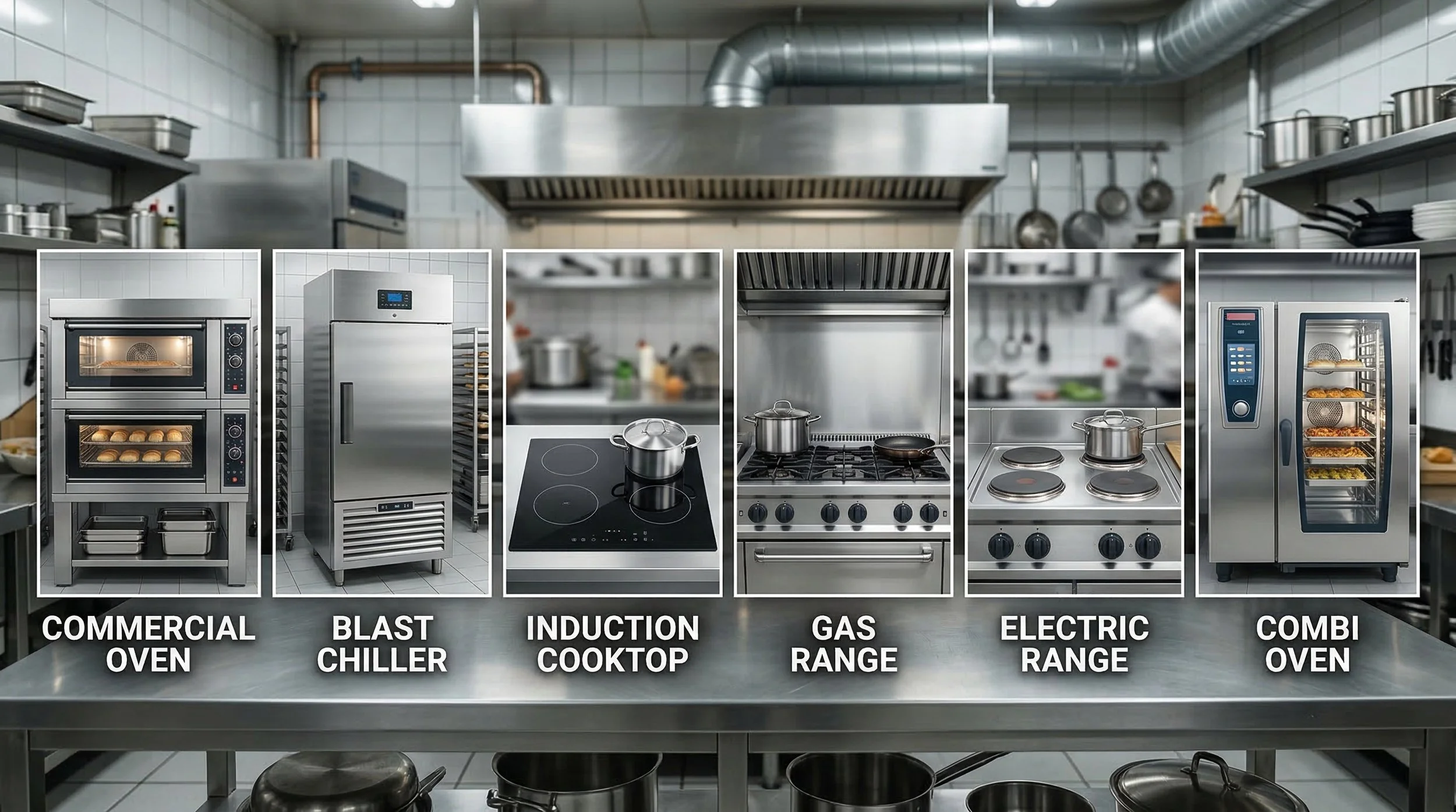
Professional Kitchen Equipment — A Complete Guide
Step into a professional kitchen and the equipment looks and feels entirely different from what you'd find at home. Everything is bigger, faster, more powerful, and built to withstand the relentless demands of a commercial environment. Understanding professional kitchen equipment not only gives you insight into how restaurant food is produced — it also makes you a better cook at home. Here's a complete guide to the essential equipment that powers professional kitchens around the world.
Commercial Ovens — And How They Differ from Domestic Ones
The oven is the heart of any kitchen, and the gap between a domestic oven and a commercial one is enormous. It's not just a matter of size — it's a fundamentally different level of performance, precision, and durability.
How Commercial Ovens Work
Commercial ovens are built to run continuously, often for twelve to sixteen hours a day, seven days a week, without loss of performance. They reach higher temperatures faster, recover heat more quickly after the door is opened, and distribute that heat far more evenly than domestic models. Most commercial ovens use forced convection — fans that circulate hot air throughout the oven cavity — which cooks food faster and more uniformly than the static heat of a conventional domestic oven.
Key Differences from Domestic Ovens
Temperature recovery is one of the most significant differences. Every time you open an oven door, heat escapes and the temperature drops. A domestic oven may take several minutes to return to temperature — during a busy service in a restaurant kitchen, that loss of time is unacceptable. Commercial ovens are designed to recover temperature almost instantly.
Capacity is another major factor. Commercial ovens are built around standard gastronorm tray sizes, allowing multiple full trays to be loaded simultaneously. A domestic oven might hold one or two baking trays; a commercial oven can hold ten, twenty, or more — cooking everything evenly at the same time.
Construction and durability set commercial ovens apart as well. Stainless steel interiors and exteriors, heavy-duty door hinges, industrial seals, and reinforced shelving are all designed to withstand the physical demands of a professional environment where equipment is used hard and cleaned aggressively every single day.
Programmability in modern commercial ovens allows chefs to store precise cooking programmes for individual dishes — exact temperatures, fan speeds, humidity levels, and cooking times — so that results are perfectly consistent regardless of which member of the team is operating the oven.
Types of Commercial Oven
Convection ovens are the workhorse of the professional kitchen — forced-air ovens that cook evenly and efficiently across multiple trays. They're used for everything from roasting and baking to reheating and finishing.
Deck ovens use stone or ceramic decks that store and radiate heat directly into the base of whatever sits on them — essential for artisan bread and pizza where direct contact with a hot surface is crucial to achieving the right crust.
Rack ovens are large rotating ovens designed for high-volume bakery production — entire racks of trays rotate inside the oven for perfectly even baking across every single shelf.
Chef's insight: The single biggest advantage of a commercial oven over a domestic one is consistency. In a professional kitchen, the same dish must come out identically every time it's ordered, regardless of what else is in the oven. That level of reliability is what commercial equipment is engineered to deliver.
Blast Chillers — And Their Role in Food Safety
The blast chiller is one of the most important pieces of equipment in any professional kitchen — and one of the least understood outside of the industry. While most attention goes to cooking equipment, what happens to food after it's cooked is equally critical to both safety and quality.
What a Blast Chiller Does
A blast chiller rapidly reduces the temperature of cooked food using powerful refrigerated airflow. Where a domestic refrigerator might take hours to cool a large batch of hot food — potentially holding it in the danger zone of 8°C to 63°C for a dangerous length of time — a blast chiller brings food from cooking temperature down to a safe storage temperature of 3°C in just 90 minutes or less. For deep-freezing, a blast chiller can reduce food to -18°C in around four hours.
Why It Matters for Food Safety
Bacteria multiply most rapidly between 8°C and 63°C — a range known as the temperature danger zone. The longer food spends in this range, the greater the risk of harmful bacterial growth. Traditional cooling methods — leaving food on a counter or placing it directly in a refrigerator — are slow and place every other item in the refrigerator at risk from the heat of the hot food being introduced. A blast chiller eliminates the danger zone almost entirely, passing through it so quickly that bacteria have virtually no time to multiply.
Food safety regulations in most countries specify maximum cooling times for cooked food — and in a professional kitchen operating at volume, a blast chiller is the only reliable way to consistently meet those standards.
Beyond Food Safety — Quality Preservation
Blast chilling isn't just about safety — it also preserves quality in ways that slow cooling cannot. Rapid chilling locks in moisture, colour, texture, and flavour. Vegetables retain their vibrant colour. Sauces maintain their consistency. Proteins don't continue cooking in residual heat. The difference in quality between blast-chilled food and slowly cooled food is clearly visible and noticeable on the plate.
Cook-chill systems — where food is cooked in bulk, blast chilled, stored, and regenerated to order — are the backbone of high-volume catering operations, hospital kitchens, airline catering, and large event cooking. Without the blast chiller, this system simply wouldn't be safe or practical.
Chef's insight: A blast chiller also extends the shelf life of prepared food significantly. Blast-chilled food stored at the correct temperature can safely last up to five days — compared to just one or two days for food that has been cooled conventionally. In a busy kitchen, that difference in shelf life has a direct impact on food waste and profitability.
Induction vs Gas vs Electric — A Professional Comparison
The choice of cooking surface is one of the most debated topics in professional kitchens. Each system has its advocates, its strengths, and its limitations. Here's an honest, detailed comparison of all three.
Gas Range
Gas has been the default choice in professional kitchens for generations, and for good reason. An open flame provides instant, visible, fully controllable heat that experienced chefs can read and respond to intuitively. Turn the knob and you have heat — immediately and precisely.
Advantages: Instant heat with no warm-up time. Precise, responsive control — you can see the flame and adjust it instantly. Works with any cookware regardless of base material. Excellent for high-heat techniques like flambéing, charring, and wok cooking. Continues to work during power outages.
Disadvantages: Gas combustion produces carbon monoxide, nitrogen dioxide, and water vapour — requiring powerful extraction ventilation. The open flame is a fire risk and requires strict safety protocols. Cleaning around burners and grates is labour-intensive. Gas prices and supply infrastructure add operational complexity.
Best for: High-heat cooking, wok work, flambéing, and kitchens where chefs are trained to cook by feel and flame response.
Induction Cooktop
Induction technology has transformed professional cooking over the past decade. Rather than heating a surface that then heats the pan, induction uses electromagnetic energy to heat the pan itself directly — making it the most energy-efficient cooking method available.
Advantages: Extremely energy efficient — nearly all the energy produced goes directly into the pan with minimal waste. The cooking surface itself stays relatively cool, dramatically reducing burn risk and making it safer in busy kitchen environments. Precise and responsive temperature control — almost as fast as gas to adjust. Easier to clean — spills don't burn onto a cool surface. No combustion means no harmful gases and significantly reduced ventilation requirements.
Disadvantages: Only works with ferromagnetic cookware — stainless steel and cast iron work perfectly, but copper and aluminium pans without a magnetic base will not. Higher upfront equipment cost. Requires a reliable electricity supply.
Best for: Precise temperature-sensitive cooking, sauce work, pastry kitchens, and modern kitchen environments prioritising energy efficiency and safety.
Electric Range
The electric range — with traditional coil or ceramic hob elements — is the least common choice in serious professional kitchens, though it remains widely used in smaller operations, catering facilities, and domestic settings.
Advantages: Lower equipment cost than induction. Works with all cookware types. Simple to operate and maintain.
Disadvantages: Slow to heat up and slow to cool down — the lag in temperature response is the electric range's biggest limitation in a fast-moving professional kitchen. Less precise than both gas and induction. Higher energy consumption than induction for the same output.
Best for: Lower-volume operations, budget-conscious setups, and environments where precise heat control is less critical.
The Professional Verdict
Most modern professional kitchens are moving toward induction for the majority of their cooking surfaces, retaining gas for specific high-heat applications where the open flame is genuinely necessary — wok stations, flambé work, and charring. Electric ranges are increasingly rare in serious professional environments.
Combi Ovens Explained
The combi oven — short for combination oven — is arguably the single most versatile and transformative piece of equipment in the modern professional kitchen. It combines three distinct cooking modes in one unit, giving chefs a level of control over heat and moisture that no other single appliance can match.
How a Combi Oven Works
A combi oven operates in three modes, which can be used individually or combined in any proportion:
Convection mode circulates dry hot air throughout the oven — identical in principle to a standard convection oven. It's used for roasting, baking, and grilling where dry heat and browning are the goal.
Steam mode injects steam into the oven cavity, creating a moist cooking environment. It's used for steaming vegetables, fish, and delicate proteins, cooking rice and grains, and reheating food without drying it out.
Combination mode — and this is where the combi oven becomes truly extraordinary — uses both dry heat and steam simultaneously, in any ratio the chef specifies. This allows precise control over the moisture level of the cooking environment throughout the entire cooking process.
Why the Combi Oven Is a Game Changer
The ability to control both temperature and humidity independently opens up cooking possibilities that simply don't exist with conventional equipment.
Bread baked in a combi oven can have steam injected during the first phase of baking — which keeps the crust soft and allows maximum oven spring — before switching to dry convection heat to develop a perfectly crisp, golden crust. This replicates the deck oven conditions of an artisan bakery in a single programmable step.
Meat roasted in a combi oven can be cooked at a precise low temperature with controlled humidity to retain maximum moisture throughout the cook, then finished with a blast of dry high heat to caramelise the surface. The result is consistently more juicy, evenly cooked, and better presented than meat cooked in a conventional oven.
Vegetables steamed in a combi oven retain their colour, nutrients, and texture far better than those boiled in water, because steam cooking is gentler and more even — and the temperature can be controlled to within a single degree.
Programmability and Consistency
Modern combi ovens are highly programmable, storing hundreds of cooking programmes that can be recalled at the touch of a button. Once a chef has perfected a cooking programme for a specific dish, that programme can be replicated exactly — every service, by any member of the team — producing identical results every time. In a high-volume professional kitchen, this consistency is invaluable.
Combi Ovens in the Home Kitchen
While combi ovens were once exclusively professional equipment, compact domestic versions are now available at increasingly accessible price points. For serious home cooks, a countertop combi oven represents one of the most significant upgrades possible — bringing professional-level control over heat and moisture into the home kitchen for the first time.
Chef's insight: If there is one piece of professional kitchen equipment that has changed the way chefs cook more than any other in the past thirty years, it is the combi oven. The control it offers over the cooking environment — temperature, humidity, airflow, and time — puts dishes on the plate that simply weren't achievable before it existed.
Professional kitchen equipment isn't just about scale — it's about precision, consistency, and control. Understanding how these tools work gives every cook, professional or home, a deeper appreciation of what it takes to produce great food reliably, safely, and at its very best.