
SMALL KITCHEN TOOLS AND GADGETS
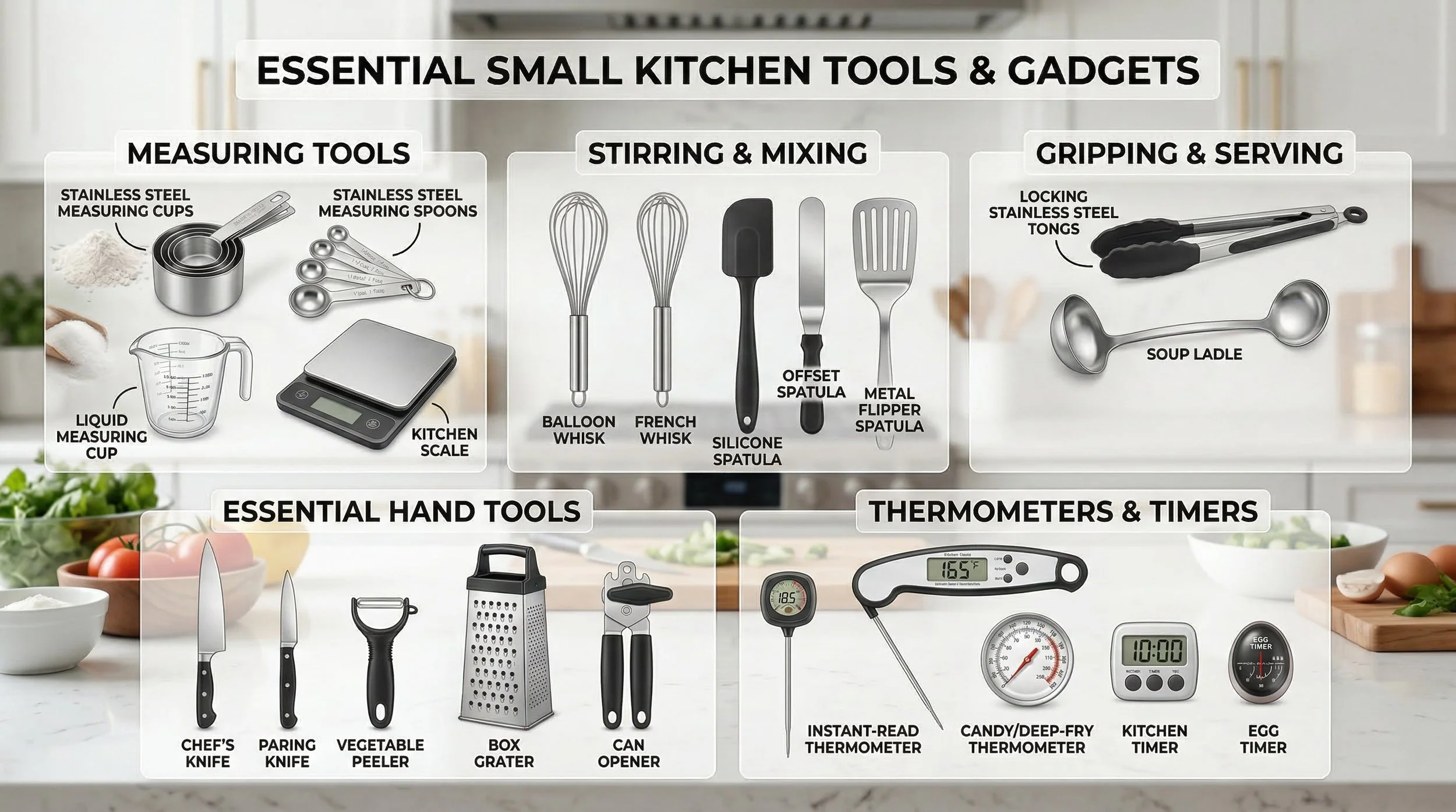
Essential Small Kitchen Tools & Gadgets
The big-ticket items get all the attention — the stand mixer, the expensive knife set, the cast iron skillet. But it's the small tools that keep a kitchen running smoothly every single day. Here's a complete guide to the essential small kitchen tools every home cook needs, organised exactly as they should be.
Measuring Tools
Cooking is creative. Baking is science. And even in everyday cooking, accuracy makes the difference between a dish that works and one that doesn't. The right measuring tools take the guesswork out of the kitchen entirely.
Stainless Steel Measuring Cups Measuring cups are used for dry ingredients — flour, sugar, oats, breadcrumbs, and similar. A standard set includes quarter cup, third cup, half cup, and full cup measures. Stainless steel is the preferred choice — it's durable, doesn't absorb odours, and won't warp or crack over time like plastic. The correct technique for dry ingredients is to spoon the ingredient into the cup and level it off with a straight edge — never scoop directly from the bag, as this compacts the ingredient and throws off your measurement.
Stainless Steel Measuring Spoons Measuring spoons handle small quantities of both dry and liquid ingredients — spices, baking powder, vanilla extract, salt, and oils. A standard set covers a quarter teaspoon, half teaspoon, teaspoon, and tablespoon. As with measuring cups, always level off dry ingredients for accuracy. Stainless steel spoons are far more durable and hygienic than plastic alternatives and won't stain or retain flavours.
Liquid Measuring Cup Liquids need their own dedicated measuring vessel — a transparent jug with clearly marked measurements on the side. The key is to place it on a flat surface and read the measurement at eye level, looking at where the bottom of the liquid's curve — the meniscus — meets the marked line. Using a dry measuring cup for liquids is imprecise and messy; always use the right tool for the job.
Kitchen Scale The kitchen scale is the most accurate measuring tool in the kitchen and the one professional bakers and chefs rely on above all others. Weighing ingredients rather than measuring by volume eliminates nearly all measuring errors — a cup of flour can vary enormously depending on how it's scooped, but 200 grams of flour is always exactly 200 grams. A digital scale with a tare function — which resets to zero after each ingredient is added — makes multi-ingredient recipes fast and clean. If you only add one measuring tool to your kitchen, make it a scale.
Stirring & Mixing
These are the tools that bring everything together — from emulsifying a sauce to flipping a pancake. Each one is designed for a specific task, and having the right one in your hand makes a noticeable difference.
Balloon Whisk The balloon whisk is the classic, wide-bodied whisk with a rounded shape that's designed to incorporate as much air as possible. It's the go-to choice for whipping cream, whisking egg whites to stiff peaks, making meringue, and aerating batters. The large surface area moves efficiently through liquid, introducing air with every stroke.
French Whisk The French whisk — also called a sauce whisk — is narrower and more elongated than a balloon whisk, making it better suited to working in saucepans and reaching the corners and edges of a pan. It's the preferred choice for making sauces, gravies, vinaigrettes, and custards — anywhere you need control and precision rather than volume.
Silicone Spatula The silicone spatula is one of the most hardworking tools in the kitchen. Its flexible, heat-resistant head is perfect for scraping every last bit of batter from a bowl, folding ingredients gently together, stirring sauces without scratching pans, and working with non-stick cookware. Unlike rubber spatulas, silicone spatulas can withstand high heat without melting or degrading, making them safe for use on the hob as well as in mixing bowls.
Offset Spatula The offset spatula has a long, thin, flexible metal blade set at an angle from the handle — that offset design is what makes it so useful. It's the essential tool for spreading frosting and buttercream smoothly across cakes, lifting delicate baked goods, and spreading batters evenly in tins. Professional bakers consider it indispensable.
Metal Flipper Spatula The metal flipper — or fish slice — is a wide, flat spatula with slots or holes in the blade to allow fat and liquid to drain away. It's designed for turning and lifting food during cooking — flipping burgers, turning fish fillets, lifting pancakes, and moving food from pan to plate. A thin, flexible edge is key — it should slide cleanly under food without tearing it.
Gripping & Serving
These tools are your hands in the kitchen — reaching into hot pans, serving soups, and moving food with precision and control.
Locking Stainless Steel Tongs A good pair of tongs is one of the most used tools in any kitchen. They act as an extension of your hand — turning meat in a hot pan, tossing pasta, gripping corn on the cob, plating food, and handling anything too hot to touch. Locking tongs are practical because they collapse flat for easy storage. Stainless steel tips are more hygienic and durable than silicone, though silicone-tipped tongs are better for non-stick cookware. Look for tongs with a good spring tension — firm enough to grip securely but not so stiff that they tire your hand.
Soup Ladle The soup ladle is designed for one primary job — transferring liquid from pot to bowl cleanly and without spilling. A deep, rounded bowl and a long handle keep your hands safely away from hot liquid. It's essential for soups, stews, sauces, and stocks, and useful for portioning out risotto, curry, and any other saucy dish. Stainless steel ladles are the most durable and hygienic option — they won't absorb odours or stain.
Essential Hand Tools
Beyond knives, these are the small hand tools that come up again and again in everyday cooking. Simple, inexpensive, and completely essential.
Chef's Knife The chef's knife is the single most important tool in the kitchen — covered in full in our knife guide, but worth mentioning here as an essential hand tool no kitchen should be without. An 8-inch chef's knife handles the vast majority of all prep work.
Paring Knife Small, precise, and incredibly versatile. The paring knife handles the detailed work a chef's knife can't — peeling, trimming, scoring, and any task requiring close control with a small blade.
Vegetable Peeler A sharp, comfortable peeler is something you'll reach for every day. Whether it's potatoes, carrots, butternut squash, or apples, a good peeler makes light work of what would otherwise be a tedious task. Replace it when it starts to drag rather than glide — a worn peeler requires more force and is more likely to slip.
Box Grater Four sides, four functions. The box grater's coarse side handles cheese and vegetables, the medium side works for softer ingredients, the fine side is perfect for hard cheeses and chocolate, and the slicing side produces thin, even cuts. It's one of the most versatile tools in the kitchen and an absolute staple.
Can Opener Simple, essential, and easy to overlook until you need one. A good can opener should cut cleanly, feel comfortable in the hand, and be easy to clean. Stainless steel construction is far more durable and hygienic than plastic, and a smooth-edge can opener that cuts around the side of the lid rather than the top eliminates sharp edges entirely.
Thermometers & Timers
Temperature and timing are two of the most important variables in cooking and baking. These tools take the uncertainty out of both.
Instant-Read Thermometer The instant-read thermometer is one of the most valuable tools a cook can own. It gives you an accurate internal temperature reading within seconds, taking all the guesswork out of whether meat is properly cooked. Chicken to 74°C, medium-rare steak to 57°C, pork to 63°C — a thermometer tells you exactly where you are without cutting into the meat and losing precious juices. It's also essential for tempering chocolate, making caramel, and checking the temperature of oil for frying.
Candy / Deep-Fry Thermometer Unlike the instant-read thermometer, the candy and deep-fry thermometer is designed to stay in the pot during cooking, giving you a continuous temperature reading. Sugar work is entirely temperature-dependent — soft ball, hard ball, soft crack, hard crack, and caramel all happen at precise temperatures that cannot be judged by eye. Deep frying equally requires oil to be held at a consistent temperature — too low and food absorbs oil and becomes greasy; too high and the outside burns before the inside is cooked.
Kitchen Timer Multitasking is the reality of cooking — multiple dishes at different stages, all needing attention at different moments. A dedicated kitchen timer keeps you honest. While most people use their phone, a standalone digital kitchen timer on the counter is faster, easier to set, and impossible to accidentally silence. Look for one with a loud, clear alarm and simple controls.
Egg Timer The egg timer is a simple, dedicated tool for one of the most deceptively tricky cooking tasks — boiling eggs to exactly the right doneness. Soft, medium, or hard — the difference is often just a minute or two, and an egg timer removes any ambiguity. The classic mechanical egg timer needs no batteries and is satisfyingly simple to use.
The best-equipped kitchen isn't the one with the most expensive equipment — it's the one where every tool has a purpose, everything is within reach, and nothing is missing when you need it most.