
STORAGE AND ORGANISATION
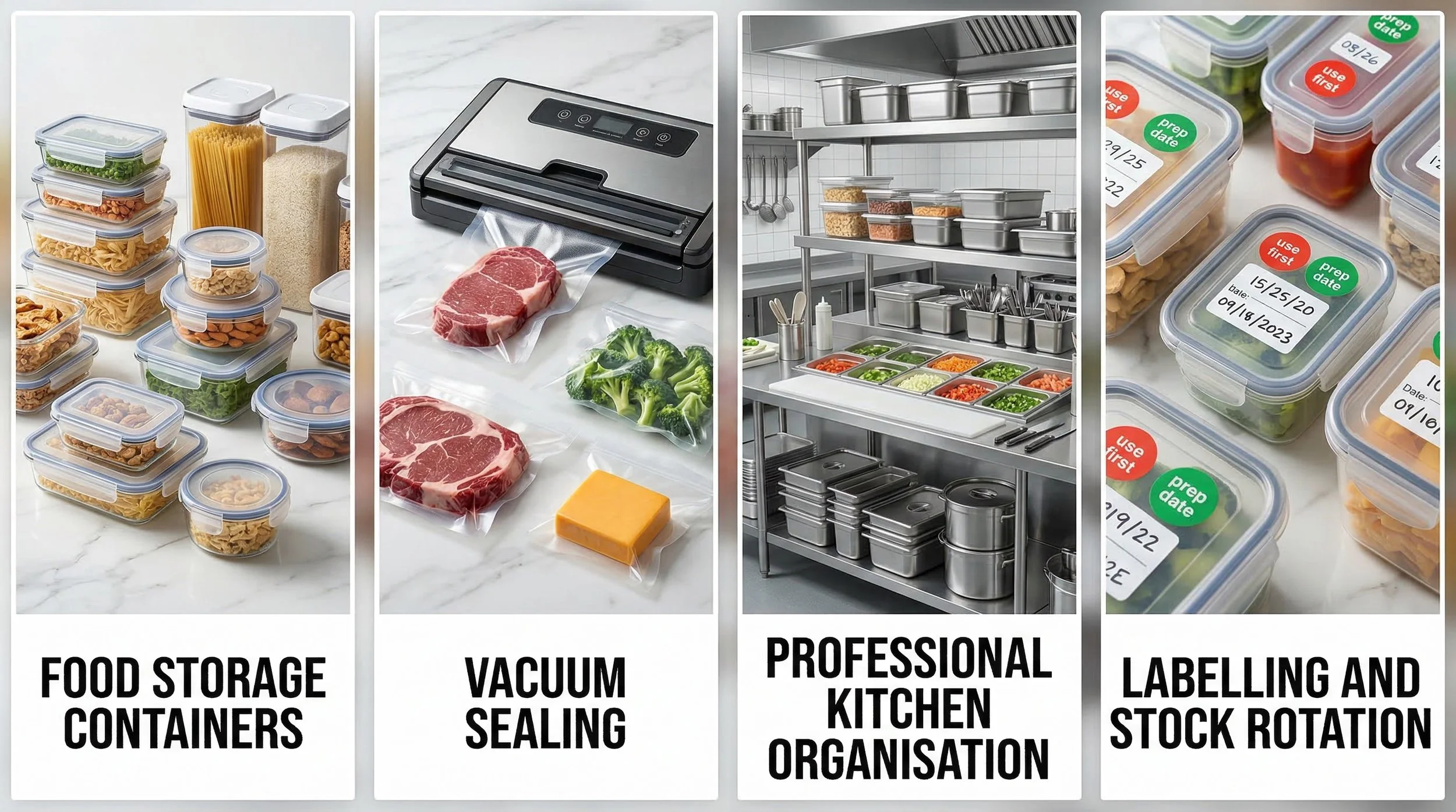
Storage & Organisation — The Complete Kitchen Guide
Food storage and kitchen organisation are the unsung heroes of good cooking. A well-organised kitchen doesn't just look better — it works better, wastes less, and keeps food safer. Whether you're running a professional kitchen or simply trying to get more out of your home refrigerator, understanding the principles of proper storage, organisation, and stock rotation will transform the way you cook and shop. Here's everything you need to know.
Food Storage Containers and Best Practices
The container you store food in matters far more than most people realise. The right container preserves freshness, prevents contamination, saves space, and reduces waste. The wrong one accelerates spoilage, transfers flavours, and creates chaos in your refrigerator and cupboards.
Types of Food Storage Containers
Glass containers are the gold standard for food storage. They are non-porous, which means they don't absorb odours, stains, or flavours from the food stored inside them. They are completely safe for use in the microwave and oven, easy to clean thoroughly, and last indefinitely with proper care. Glass containers are particularly good for storing acidic foods like tomato sauce, curries, and citrus-based dishes that would stain or degrade plastic over time. The only real drawbacks are weight and the risk of breakage — glass containers are heavier and less forgiving of drops than plastic alternatives.
Plastic containers are lightweight, inexpensive, and practical for everyday use. Not all plastics are equal, however — always look for BPA-free containers, as older or lower-quality plastics can leach chemicals into food, particularly when heated. High-quality plastic containers with airtight lids are excellent for dry goods, leftovers, and meal prep. Avoid storing acidic or oily foods in plastic for extended periods, as these accelerate the breakdown of the material and can cause flavour transfer.
Stainless steel containers are durable, hygienic, and completely non-reactive — they will never absorb flavours or leach chemicals. They are the container of choice in professional kitchens for good reason. The limitation is that they are not transparent, so you can't see the contents at a glance, and they are not suitable for microwave use.
Silicone bags and containers are a sustainable and increasingly popular alternative to single-use plastic bags. Flexible, reusable, dishwasher safe, and available in a wide range of sizes, they are excellent for storing everything from fruit and vegetables to marinated meat and packed lunches.
Best Practices for Food Storage
Airtight seals are the single most important feature of any food storage container. Exposure to air is the primary driver of spoilage — it dries out food, promotes oxidation, and allows bacteria and mould to establish themselves. Always check that lids seal firmly and replace containers whose lids have warped or no longer close securely.
Store raw and cooked food separately at all times. Raw meat, fish, and poultry should always be stored on the lowest shelf of the refrigerator — below all other food — to prevent any drips or leaks from contaminating cooked food or fresh produce below. This is not just good practice; in a professional kitchen it is a legal requirement.
Cool food before refrigerating. Placing hot food directly into the refrigerator raises the internal temperature of the entire unit, putting other stored food at risk. Allow cooked food to cool to room temperature — ideally within two hours — before sealing and refrigerating. In a professional kitchen, a blast chiller handles this process rapidly and safely.
Use the right container for the right food. Dry goods like flour, sugar, rice, pasta, and grains should be stored in airtight containers away from heat, light, and moisture — a cool, dark cupboard is ideal. Fresh herbs store best standing upright in a small amount of water, loosely covered. Cheese benefits from being wrapped in wax paper rather than cling film, which traps moisture and promotes mould.
Don't overfill your refrigerator. Air needs to circulate freely around food in a refrigerator for it to cool evenly and efficiently. An overcrowded refrigerator works harder, uses more energy, and cools less effectively. Leave space between items and avoid blocking the vents.
Vacuum Sealing at Home
Once the exclusive territory of professional kitchens, vacuum sealing has become one of the most accessible and genuinely useful tools available to the home cook. A good vacuum sealer pays for itself quickly in reduced food waste, extended storage life, and better food quality.
How Vacuum Sealing Works
A vacuum sealer removes air from a specially designed bag or container and heat-seals it shut, creating an airtight environment around the food. Without air, the oxidation process that causes food to deteriorate slows dramatically. Bacteria and mould that require oxygen to grow are deprived of it. Freezer burn — which is caused by moisture evaporating from the surface of food and forming ice crystals — is virtually eliminated.
The Benefits of Vacuum Sealing at Home
Extended shelf life is the most immediate benefit. Vacuum-sealed food lasts significantly longer than food stored in standard containers or bags. Fresh meat that would last two to three days in a conventional refrigerator can last up to two weeks when vacuum sealed. In the freezer, vacuum-sealed food maintains quality for one to three years, compared to just a few months for conventionally stored food.
Preservation of quality sets vacuum sealing apart from other storage methods. Because oxidation and moisture loss are minimised, food retains its colour, texture, and flavour far better than food stored conventionally. Vacuum-sealed strawberries look and taste like fresh strawberries days after they would otherwise have started to deteriorate.
Faster marinating is one of the less obvious but enormously useful benefits of vacuum sealing. When food is vacuum sealed with a marinade, the reduction in atmospheric pressure causes the marinade to penetrate the meat far more rapidly than conventional marinating. A steak that would normally need to marinate overnight can be thoroughly flavoured in as little as thirty minutes under vacuum.
Sous vide cooking is only possible with vacuum sealing. If you own or plan to own a sous vide machine, a vacuum sealer is an essential companion — it allows you to seal food safely and precisely at the exact temperature required for sous vide cooking.
Portion control and meal prep become dramatically more efficient with a vacuum sealer. Buy in bulk, portion into individual or family-sized servings, seal each portion, and freeze. Your freezer becomes a neatly organised, clearly labelled resource rather than a chaotic jumble of frost-covered bags.
Tips for Vacuum Sealing at Home
Always leave at least three inches of space above the food in the bag to ensure a clean, strong seal. For liquid-rich foods like soups and stews, freeze first in a container until solid, then vacuum seal the frozen block — this prevents liquid from being drawn into the sealer mechanism. Delicate items like soft fruits, fresh bread, and cooked pastry should be pre-frozen or sealed on a gentle setting to avoid crushing. Always label every sealed bag with the contents and date before freezing — sealed bags are notoriously difficult to identify once frozen.
Organising a Professional Kitchen
A professional kitchen is one of the most demanding working environments in any industry. It operates at high speed, under pressure, in intense heat, with multiple people working simultaneously in a confined space. Without rigorous organisation, the whole system breaks down. The principles that govern professional kitchen organisation are directly applicable at home — scaled down, but no less effective.
The Brigade System and Stations
The professional kitchen is organised around stations — each chef responsible for a specific section of the menu and the equipment that goes with it. The hot section handles mains, the cold section handles starters and salads, the pastry section handles desserts, and so on. Everything each chef needs is within arm's reach of their station — their mise en place prepared and arranged before service begins.
Mise en place — French for "everything in its place" — is the foundational principle of professional kitchen organisation. Before service starts, every ingredient is prepped, portioned, and arranged in the exact position where it will be needed. Sauces are made and kept warm. Garnishes are cut and ready. Every pan, utensil, and seasoning is in its designated place. Nothing is left to chance.
The lesson for the home cook is straightforward — before you start cooking, read the recipe fully, prepare all your ingredients, and have everything within reach. Cooking from a state of organised preparation is a fundamentally different and better experience than searching for ingredients mid-cook.
Storage Organisation in a Professional Kitchen
Professional kitchens use a zoned storage system where everything has a designated place and is always returned to that place. Dry goods are stored in clearly labelled airtight containers on dedicated shelving, organised by frequency of use — the things used most often are most accessible. Refrigerators are organised by food safety zones — raw proteins on the bottom, cooked and ready-to-eat food above, dairy and produce in designated areas.
Shelving in a professional kitchen is almost always stainless steel — hygienic, easy to clean, and durable. Containers are uniformly sized where possible, which makes stacking efficient and maximises storage capacity. Wire shelving allows air to circulate freely, preventing moisture build-up and the mould that comes with it.
Every container, every shelf, and every storage area is clearly labelled. In a kitchen where multiple people work across multiple shifts, labelling is not optional — it is the system that keeps everything functioning correctly regardless of who is on duty.
Applying Professional Organisation Principles at Home
You don't need a professional kitchen to benefit from professional organisation principles. Decant dry goods into clear, uniform airtight containers and label them — your cupboards will be easier to navigate and your ingredients will stay fresher. Designate specific areas of your refrigerator for specific food types and stick to them consistently. Store the things you use most often at eye level and within easy reach. Keep your most-used tools — the knife, the peeler, the spatula — immediately accessible rather than buried in a drawer.
A well-organised kitchen reduces waste, speeds up cooking, and makes the whole experience more enjoyable. The investment of an hour or two organising your kitchen properly repays itself every single day.
Labelling and Stock Rotation
In a professional kitchen, unlabelled food is unacceptable — it is a food safety risk and an operational failure. In a home kitchen, unlabelled food is the primary cause of the mysterious frozen parcels and forgotten leftovers that get thrown away uneaten. A simple, consistent labelling and stock rotation system solves both problems entirely.
Why Labelling Matters
Memory is unreliable. A container placed in the refrigerator on Monday looks identical to one placed there on Thursday. Without a label, there is no way to know which is which — and in a professional kitchen operating under food safety regulations, guessing is not an option. Every item of prepared food in a professional kitchen must be labelled with what it is and when it was made. No exceptions.
At home, the same principle applies. A labelled container tells you at a glance what it contains, when it was made, and how long it can safely be kept. This single habit eliminates the uncertainty that causes perfectly good food to be thrown away unnecessarily — and prevents the genuine food safety risk of eating something that has been kept too long.
What to Include on a Label
A proper food label needs three things — the name of the item, the date it was prepared or opened, and the use-by date. In a professional kitchen, labels also often include the name of the person who prepared the item, the storage temperature required, and any allergen information. At home, name and date are the minimum — but adding a use-by date makes decision-making in the refrigerator instant and effortless.
Labelling equipment doesn't need to be expensive or complicated. A roll of masking tape and a permanent marker is all you need for home use. Professional kitchens use colour-coded dissolvable labels — designed to dissolve completely in the dishwasher so no residue remains on containers — which are an excellent investment if you want to apply professional standards at home.
Colour-Coded Labelling Systems
Many professional kitchens use a day-of-the-week colour-coded labelling system — a different colour for each day — which makes stock rotation visually instant. A chef can look at a shelf and see at a glance which items are from which day without reading a single label. This system is particularly effective in high-volume environments where speed and clarity are essential.
Colour coding is also used to indicate allergen information — specific colours assigned to dishes containing common allergens such as nuts, gluten, or dairy — so that every member of the team can identify allergen-relevant items instantly and without ambiguity.
Stock Rotation — FIFO
Stock rotation is governed by one simple principle — First In, First Out, universally known in the industry as FIFO. The oldest stock is always used first. New deliveries go to the back of the shelf; existing stock moves to the front. This sounds obvious, but without a deliberate system it is remarkably easy to reach for the nearest item at the front while older stock sits untouched at the back until it spoils.
In a professional kitchen, FIFO is non-negotiable and applies to every item in every storage area — dry goods, refrigerated items, frozen stock, and everything in between. Every new delivery is dated and placed behind existing stock. Every team member is trained to follow FIFO as standard practice.
At home, the same principle is equally valuable. When you unpack your shopping, move older items to the front and put new ones behind. In the refrigerator, keep older leftovers at eye level where they'll be seen and used. Check your cupboards regularly and move items approaching their best-before dates to the front where they'll be used next.
The Cost of Poor Stock Rotation
Food waste is one of the most significant costs in a professional kitchen — and one of the most controllable. Poor labelling and stock rotation are among the leading causes of avoidable waste. Ingredients that spoil before use, leftovers that are forgotten and thrown away, and deliveries that sit unused while older stock deteriorates — all of these represent direct financial losses that a simple labelling and rotation system prevents.
At home, the same logic applies. The average household throws away a significant amount of food every week — much of it perfectly edible food that was simply forgotten, misidentified, or kept past its usable date without anyone realising. A consistent labelling and FIFO system is one of the simplest and most effective steps any household can take to reduce food waste and save money.
Organisation isn't about perfection — it's about systems. Simple, consistent habits around storage, labelling, and stock rotation make every kitchen safer, less wasteful, and more enjoyable to work in. Whether you're running a Michelin-starred restaurant or cooking dinner for your family, the principles are exactly the same.